
Body Language During Your Medical School Interview
Making patients feel safe and heard is central to practising medicine, and at some universities, you'll be interacting with real patients as early as your first week of training. That's exactly why medical interviews put real weight on body language: how you carry yourself opening the interview, and how you read and respond to others throughout.
This article covers reading and using body language across video, in-person, and prompt-based interview formats.
Body Language in Healthcare
Patients are often distressed but try to put on a brave face, so how you communicate non-verbally shapes whether they actually feel comfortable opening up.
- Open (positive) body language: chest facing your conversation partner, arms at your sides rather than crossed. Always aim for this.
- Closed (negative) body language: the opposite, and it creates defensiveness or distance between doctor and patient.
- Active listening: direct eye contact, an expressive face, and natural nodding or hand gestures while the other person speaks. This is what actually builds rapport.
Video Interviews
Online interviews make body language harder to communicate, so preparation matters even more.
- Frame yourself properly. Sit centred in the camera frame, upright, with some space above your head.
- Straighten your posture. Shoulders back, no slouching, this reads as open and professional.
- Use hand gestures and nods deliberately. Think of them like bold text in an essay, they highlight the key points of your answer for the interviewer.
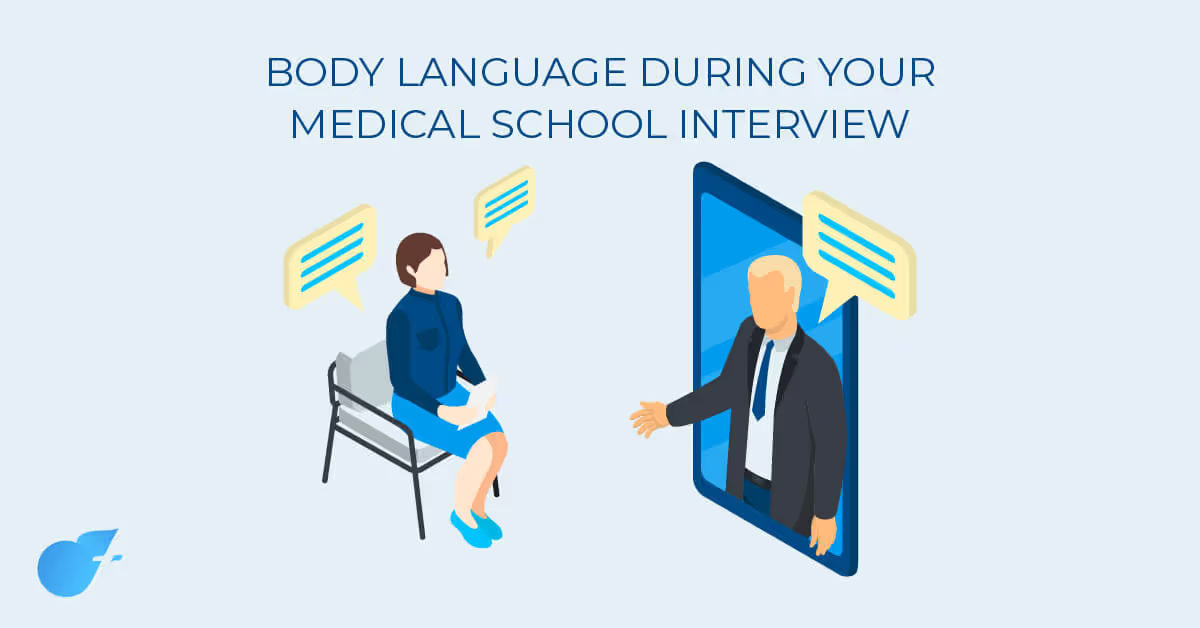
- Some MMI or panel formats include video-response prompts, where you'll watch a doctor-patient interaction and assess whether the behaviour shown was appropriate. Having a systematic approach to body language (rather than winging it) helps here directly, since you'll be applying the same framework to judge someone else's.
In-Person Interviews
- Compose yourself before you even enter: shoulders back, chest open, straight posture, relaxed rather than stiff.
- Knock before entering, even if you're expected.
- Make eye contact and smile once inside.
- Mirror your interviewer or the actor you're speaking with, it reads as more genuinely supportive.
- Sit at roughly a 45-degree angle to your conversation partner where the room allows, this feels less confrontational than sitting directly opposite, and matters especially in acting/scenario stations with a distressed "patient."
Red Flags to Avoid
- Fidgeting or rocking. Common under nerves, but reads as unprofessional. Record yourself practising to catch this before the real thing.
- Avoiding eye contact. Reads as dismissive to both interviewers and patients. For video interviews, practise looking at the camera lens itself, not your own image on screen.
- Inappropriate physical contact. Never touch an actor playing a distressed patient in a scenario station, just as you wouldn't in a real clinical setting. On handshakes: let the interviewer offer first, it's not your place to initiate.
- Absent body language. Standing too far away, avoiding eye contact, or showing no signs of active listening all read just as poorly as clearly negative body language.
Building This Skill
Talk through these ideas with friends, family, or a tutor, and compare real interview experiences. Watching examples of strong and weak doctor-patient interactions on video is also a genuinely useful way to train your eye before applying the same judgment to your own delivery.
Related Articles
- 5 Common Mistakes to Avoid in Medical Interviews — Broader red flags that can undercut an otherwise strong interview.
- 5 Common Medical Interview Strengths — How to demonstrate your strengths clearly and concisely.
- How to Perfect the Medical Interview Tone — How tone works alongside body language to build rapport.
.png)


.png)