
The STAR Technique: How to Structure Your Medical Interview Answers
Medical school interviews play a decisive role in judging whether a student has what it takes to succeed in medical school and beyond. Yet compared to a competitive psychometric test like the GAMSAT, interviews are frequently underestimated.
That's likely because interviews largely set academic transcripts aside and focus instead on who you actually are. As a result, a lot of applicants unintentionally take interview prep less seriously than they should. A test like the GAMSAT, by contrast, is highly targeted, with distinct sections built to test logical thinking under pressure, so its demands feel more obvious.
Interviews genuinely warrant their own kind of preparation. Even if some of us assume medical interviews reward pure spontaneity, Fraser's Interview Training strongly believes in deliberate preparation, since even composed, capable people can struggle with interviews if they walk in without a strategy.
That's where the STAR technique comes in: a simple, logical way to structure your answers to any question about a past experience.
What Is the STAR Technique?
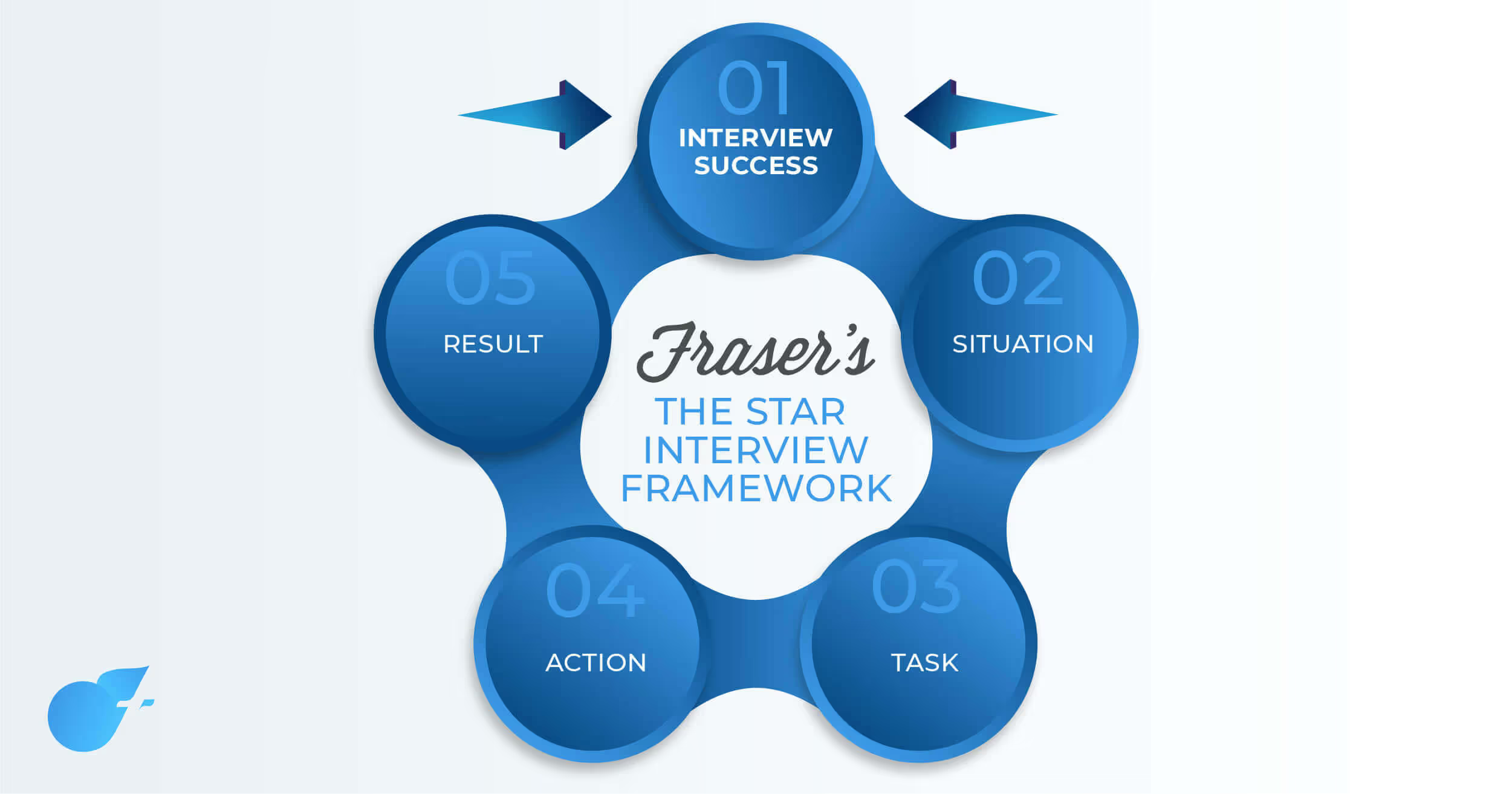
STAR is a structure for organising your interview answers. The acronym stands for:
- Situation
- Task
- Action
- Result
It's a widely recognised framework across all kinds of interviews, and it's particularly useful in a medical interview, where you need to give accurate, logically sound, and concise answers to clinical and health-related questions alike.
The structure itself is refreshingly simple. Whenever an interviewer asks a question, you can use STAR to organise your thoughts and deliver a clearer, more polished answer. Let's break down each component.
How to Use the STAR Method
To make this concrete, let's use one of the most common (and deceptively difficult) medical interview questions: "Why do you want to study medicine?" It sounds simple, but it puts real pressure on you to summarise your entire journey toward medicine in a way that's both genuine and compelling.
This kind of question calls for a thoughtful, specific answer, one that captures your motivation and shows what makes your path genuinely your own.
S: Situation
The "S" refers to the specific real-life situation or scenario you're drawing from. If you're asked about your motivation to become a doctor, your answer needs to set the scene clearly enough for the interviewer to follow.
Be genuinely specific about what drew you toward medicine. Who was involved? What actually caught your attention? Bring these details together into a concrete, honest answer that reflects real sincerity rather than a rehearsed sentiment.
Keep it concise. A lot of candidates ramble when describing personal experiences. Avoid falling back on generic lines like "I'm passionate about helping others," since these tend to work against you rather than for you. Instead, focus on what makes your particular path to medicine distinct from every other applicant in the room. Extracurricular experiences from your undergraduate years are often a great source of material here.
T: Task
Building on the situation you've set up, the "T" for Task can mean one of two things:
- A specific responsibility you had to fulfil within a set timeframe, for instance, a challenge you faced during an internship, or
- More broadly, the kind of experience or opportunity you pursued to help develop the qualities that would support your transition into medical school.
For a question like "why medicine?", either interpretation can work well. If your road to relevant experience wasn't straightforward, that struggle itself can become part of your answer, a task worth mentioning in its own right.
Try to recall a specific instance that fits the question well: a particular activity, or a situation you had to work through. Then describe your actual responsibilities, whether that involved a group project on a deadline, resolving a conflict with a colleague, or leading an initiative. This gives the interviewer a clear picture of your role and the people involved.
For example:
"I received an internship opportunity to shadow a nurse in a rural health clinic. It was exciting getting to see the vast array of ailments, and to care for people from all walks of life in the community I was in. I now understand that caring for people is a privilege. It was extremely rewarding being able to help people in their time of need, allowing them to be treated in their own community, rather than having to travel hours to the city."
A: Action
The "A" is where you show what you actually did about the task you've just described. This is where your interpersonal qualities come through most clearly.
A few things to keep in mind as you build this part of your answer:
- Keep it personal. Focus on your own perspective and actions rather than describing what others around you did.
- Highlight the specific approach you took, including any trial and error, which often says a lot about initiative and resilience.
- Cover what you did, how you did it, and why you made that particular choice.
R: Result
The final piece is the Result: what actually came of your action, and how it resolved the task at hand.
There are really only two broad outcomes here. Either your approach worked and led to a positive result, or it fell short in some way. Either outcome is fine to discuss, what matters is what you took away from it.
If things worked out, talk about the growth that came from it and the qualities you developed. If they didn't, don't shy away from that either. Instead, use it to show how you handle setbacks, which is often just as compelling, if not more so, than a clean success story.
Where to From Here?
We hope this gives you a solid, repeatable structure for building your own medical interview answers. The STAR technique is simple to apply, and the more naturally you use it, the more receptive interviewers tend to be to what you're actually saying, which also does wonders for your tone and overall delivery on the day.
Related Articles
- What's Your Greatest Weakness? — A detailed breakdown of one of the toughest questions you're likely to face.
- 5 Common Medical Interview Strengths — How to talk about your strengths without sounding rehearsed.
- How to Prepare for a Medical Interview: Solo Preparation — What to focus on if you're preparing without a study partner.
- Medical School Interviews: What to Wear? — Practical guidance on interview dress code.
.png)


.png)